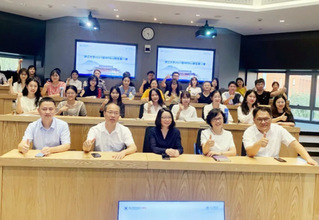


Seminar NO.71 by Department of Service Science and Operations Management
Date: Friday, 23 October 2026
Time:9:30 AM
Venue: SOM A523
Host: Lina Bao, ZJU 100 Young Professor
Topic 1: Data aggregation for prediction and decision making
Speaker: Associate Professor Chengzhang Li, Shanghai Jiao Tong University

Bio:
Chengzhang Li is an Associate Professor in Management Science at Antai College of Economics and Management, Shanghai Jiao Tong University (SJTU). Prior to joining SJTU, he received his M.S. in Statistics and Computer Science and his Ph.D. in Operations Management from Purdue University, and his B.S. in Mechanical Engineering and Automation from SJTU. His research interests lie in supply chain management, data-driven decision-making, and socially responsible operations. His works have been published in Management Science, Manufacturing and Service Operations Management, and Production and Operations Management. He received several awards, including the first prize in the MSOM Practice-based Research Competition and CSAMSE Early Career Fellow. He has also received two NSFC grants as Principal Investigator and was selected for the Shanghai Pujiang Talent Program.
Abstract:
Firms increasingly need to make predictions and operational decisions for large-scale systems, often with limited data for each product, store, or problem instance. Aggregating data across related problems can alleviate data scarcity, but uncalibrated pooling may overlook heterogeneity and introduce bias. This talk presents two approaches to managing this trade-off. The first develops a flexible data aggregation framework that uses contextual information to guide aggregation across multiple levels. The second proposes a cluster-based data pooling approach that uncovers latent similarity structures and aggregates data within estimated clusters. These studies provide a framework for leveraging cross-problem information under limited data and offer practical tools for navigating the bias–variance trade-off in data-driven operations.
Topic 2: Proximal Systems for Inventory Management under Positive Lead Times
Speaker: Assistant Professor Yang Yang, Shanghai University of Finance and Economics

Bio:
Yang Yang is an Assistant Professor of Operations Management at the School of Business, Shanghai University of Finance and Economics (SUFE). Prior to joining SUFE, she was a Postdoctoral Research Associate at Purdue University and Shanghai Jiao Tong University. She received her Ph.D. in Management Sciences from City University of Hong Kong. Her research interests lie in healthcare operations management, data-driven decision-making, and stochastic optimization, with a particular focus on interpretable decision optimization for complex service systems. Her research has been published in Management Science and Operations Research.
Abstract:
Lost-sales inventory systems with positive replenishment lead times are difficult because decisions depend on the order history and stockouts truncate the inventory dynamics. We introduce proximal systems, which modify performance accounting rather than restrict the policy class. One makes old inventory free to hold and yields a constant-order policy, and the other pools orders and demand over the lead-time window and yields a base-stock policy. The proximal systems provide transparent structural insights that yield simple derivations of asymptotic optimality in the long lead-time and large-penalty regimes, respectively. We then interpolate the two proximal systems by applying a constant-order policy to one portion of demand and a base-stock policy to the remainder. Anchored at the corresponding policy parameters optimized for the original system, the resulting interpolated constant-order and base-stock policy inherits the asymptotic guarantees in both regimes. More importantly, only a one-dimensional search over the mixing parameter is required, providing sufficient flexibility for the interpolated policy to outperform other simple policies and to remain competitive with substantially more computationally intensive alternatives.

欢迎广大师生前来交流!